


Everyone has heard of AIOps and DevOps. These are the catchphrases of the 2010s; while the AIOps trend can be traced back to the DevOps culture, the two are inherently different. To the company as a whole, DevOps is a way of life, while AIOps is a step or two ahead in terms of the tools it employs and the technology it makes use of, such as machine learning and artificial intelligence. A good example of this is substituting data-driven decision making for human intervention.
The concepts of “DevOps” and “AI Operations” will be defined in this article. As we go along, here’s a snippet of their backstory. Okay, so let’s get going.
Let’s Start with DevOps
In 2008, Belgian IT consultant Patrick Debois first used the term “DevOps.” That same year, in Ghent, Belgium, he organised the first “DevOpsDays” conference to bring together developers and operations professionals to discuss ways to enhance collaboration between the two teams.
DevOps was created to break down the barriers between the traditionally separate and uncoordinated groups responsible for programme development and server administration. While operations teams were responsible for ensuring that the system remained stable and available, developers concentrated on creating and releasing new features.
By bringing together these two teams and encouraging collaboration and communication, DevOps aimed to increase the velocity and reliability of software delivery. This was accomplished by including testing and monitoring in every phase of the software development lifecycle, as well as implementing continuous integration and delivery and treating infrastructure as code.
In the years that followed, the DevOps movement gained traction and was adopted by businesses of all sizes and in a wide range of sectors. Adoption of DevOps practises has become a key driver of digital transformation across many industries, and the principles and practises of DevOps are now widely accepted and implemented.
The term “DevSecOps” describes how DevOps has expanded to incorporate security, as well as many other areas, such as ChatOps, Artificial Intelligence Operations, etc.
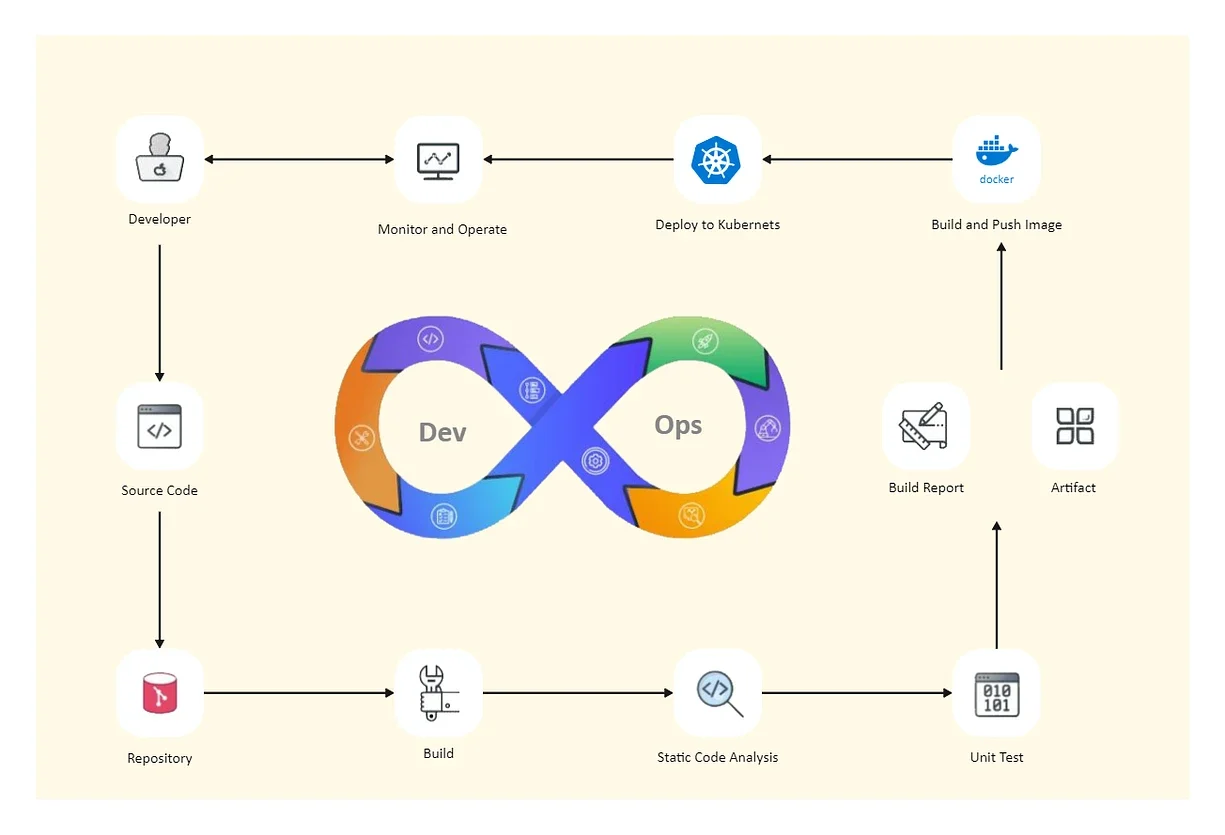
Consider these intriguing DevOps-related ideas:
- With Continuous Integration (CI), changes to the code are merged into a central repository on a regular, daily, or even minute-by-minute basis. The speed and quality of software delivery can be increased by allowing teams to quickly identify and address potential conflicts.
- The term “continuous delivery” (CD) refers to the routine of mechanically generating, testing, and releasing new versions of software to users. Teams can now release improvements and bug fixes to customers more quickly and with less risk.
- Instead of configuring hardware and software by hand, infrastructure is managed automatically through a process known as “Infrastructure as Code” (IaC). Teams can now take advantage of automation in infrastructure provisioning, configuration, and management to boost reliability and cut down on human error.
- The term “microservices” refers to an architectural pattern in which a large application is divided up into several smaller ones. Because of this, teams can develop, deploy, and scale services independently, which increases scalability and adaptability.
- DevSecOps is a methodology that merges security checks with the rest of the software creation and distribution procedure. By incorporating security experts from the get-go, projects can continuously monitor for potential security threats and address them as they emerge.
- ChatOps refers to a methodology where teams use instant messaging applications like Slack for communication and the automation of routine tasks. In this way, teams can consolidate their efforts in one location, where they can more easily share data and automate routine tasks.
Some interesting stats for you:
- In a recent survey, Forrester found that 78% of companies use DevOps in some capacity, and the market for DevOps tools is projected to hit $10 billion by 2027.
- The same Forrester survey also found that when it comes to DevOps, people value culture and processes over technology.
- A Puppet study found that companies who have fully adopted DevOps practises can speed up their code deployments by a factor of 30 compared to those who haven’t.
- Full adopters of DevOps practises can bounce back from setbacks up to 2.5 times faster than their peers, according to research conducted by CA Technologies.
- Accenture found that when compared to traditional teams, DevOps teams were more likely to have high levels of trust and minimal conflict.
- Forrester found that businesses that have implemented DevSecOps practises have significantly fewer security vulnerabilities and breaches.
Now it is about AIOps
As businesses began investigating the potential of cutting-edge tools like machine learning and data analytics to streamline and enhance their IT operations, the term “AIOps” (Artificial Intelligence for IT Operations) emerged in the early 2010s.
Automating incident management and event correlation was an early goal of AIOps, with the hope that doing so would cut down on the time and energy needed to find and fix problems. To do this, we analysed massive amounts of information gathered from various places, like log files and performance metrics, in search of anomalies and patterns that could indicate a problem.
When AIOps was more developed, it began to pay more attention to things like performance monitoring, root cause analysis, and predictive maintenance. As a result, businesses were able to optimise the efficiency of their IT systems through early detection and resolution of problems.
AIOps continued to develop and mature over the subsequent years, with an increasing number of businesses embracing its technologies and procedures. As the IT industry continues to expand, the need for AIOps to efficiently manage and optimise IT operations has grown in tandem with the volume of data generated by IT systems.
Since AIOps can aid DevOps by supplying insights and automating the development procedure, and since AIOps can aid Security by doing the same for the security procedure, AIOps has begun to integrate with other fields like DevOps and Security.
As it allows businesses to better manage their IT in terms of efficiency, effectiveness, and proactivity, AIOps is now widely regarded as a key enabler of digital transformation.
Why AIOps?
There are a number of reasons why a company might decide to use AIOps:
- Automation: AIOps can automate many of the tasks that used to be done by hand in IT operations, like managing incidents and figuring out what events are related to each other. This can help organisations cut down on the time and work needed to find and fix problems and lessen the effects of outages.
- AIOps can give organisations real-time insights and automated responses to problems, so they can be more proactive in how they manage their IT systems. This can help companies find problems before they become serious and improve the way their systems work.
Scalability: As the amount of data created by IT systems continues to grow, AIOps can help organisations manage and optimise their IT operations at scale. - Cost savings: AIOps can help organisations save money on IT operations costs by automating tasks and reducing the need for manual work.
Improved security: AIOps can help organisations improve their security by automating tasks like finding potential threats and how to deal with them and finding vulnerabilities and how to fix them. - Better collaboration: AIOps can help organisations improve how development and operations teams work together by giving insights and automating the whole IT process.
Overall, AIOps can help organisations manage their IT operations in a more efficient, effective, and proactive way. It also gives them the insights and automation they need to support their digital transformation efforts.
Some Stats for Nerds:
- Gartner predicted that by 2020, 30% of IT operations would use AI to detect and fix IT problems, up from fewer than 5% in 2016.
- MarketsandMarkets predicts that the global AIOps market will expand from $2.5 billion in 2020 to $11.8 billion in 2025, at a compound annual growth rate (CAGR) of 36.8 percent.
- Over 70% of IT departments planned to implement AIOps by 2022, per a poll by Forrester.
- ResearchAndMarkets predicts that the AIOps market in Asia Pacific will expand at the fastest rate of growth during the forecast period as a result of rising demand in countries like China and India.
- IDC discovered that businesses that have implemented AIOps have seen an average 40% boost in IT operations productivity and a 30% reduction in incident response time (I myself witnessewd this in one of our customers in India).
Statistics like these show how rapidly AIOps is being used by businesses of all sizes and in a wide variety of sectors to enhance IT operations and fuel digital transformation efforts.
Final Thoughts
In today’s multi-cloud, hybrid environment, both DevOps and AIOps are expanding. There has been a paradigm shift to using enterprise clouds, which have experienced unprecedented growth and are now significant contributors to the global economy. Because we are the ones who have created AI, we must be better than it, right? If so, then we need to make a paradigm shift in our lives where we can compete with AI and become friends with them. In order for everyone on Earth to live in peace with tremendous advances and investigation in the sphere of technology, we need just dig in and discover the best version of ourselves. Given that not everything we create will have its own unique quality, we must accept that not everything we make will have its own unique quality. To put it simply, that is mankind.
Keep reading and thanks for making this far. I wish you all the best. You can connect with me on LinkedIn and Twitter.