


As we all know how effective our life will be when we become essentialists and apply the 80/20 principle. Now, I am about to write about the 5 elements that are responsible for effective thinking. This article is the summary and my thoughts about the book, “The 5 Elements of Effective Thinking” written by Edward B. Burger and Michael Starbird.
We like to become great or we talk about people who have achieved impossible things to imagine from Einstein to Bill Gates or Steve Jobs. All those talents are not just developed or adopted in a single day. It has come from generations and inherited them. It is not only about inheritance, but they all also had that character to adopt the level of thinking that inspired them to achieve big.
There are some chapters that I listed while reading the book that will help you to change the way you think to be better than what you are now. I always tell most of the people around me to keep improving and learning. See yourself for the progress of 1% every day. Until I am the one who implements that in my personal life, I never suggest to anybody to go with it. I am the test case for every experiment of my life. When that works for me, I tell others about the effort to make sure it helps them to change the way in their life.
In this article, you will also find a few highlights, tips and try these points from the book. This will also help you to build the character that needs to be strong and collective.
All of these summaries that I am willing to write are in a series of interconnected thoughts. The first one was about being an essentialist — to eliminate difficulties in life by selecting effective few from trivial many options. The 80/20 rule suggests that the small change in life leads to the bug difference hence look for the top 20% to change the rest of 80%. This book helps to think in the ways where all of these holds in an account.
Chapters:
- Elements of effective thinking, learning and creating
- Earth: In everything you do, refine your skills and knowledge about fundamental concepts and simple cases
- Fire: Mistakes and failure are not signs of weakness; instead they are opportunities for future success
- Air: The right questions are incredibly powerful tools for understanding and learning
- Water: Successful and effective learners and innovators harness the power of the flow of ideas
- The Quintessential Element: Adopt the habit of constructive change
Elements of effective thinking, learning and creating
Already I mentioned that great minds are not just created over one night or with a gift from God. Those minds are created by continuous learning and training the mind to be strong by thinking effectively. We will only learn when we create and take risks out of it.
There are main building blocks of effective thinking, they are, Understand Deeply, Make Mistakes, Ask Questions, Follow the flow and Change These blocks are Instrumental in generating creativity in our minds that leads to think and learn effectively.
Authors also suggest that learning is eternal and it doesn’t end in formal schooling. Education is the life long teacher and we are the students who devoted to learning till our last breath. By adopting these successful habits, we can change to our lives even as a student or as a professional. All these habits are compared to the basic elements of earth, Earth, Fire, Air, Water, The quintessential element respectively.
Earth: In everything you do, refine your skills and knowledge about fundamental concepts and simple cases
While I was reading this part, the Authors strongly suggests understanding the basics when we try to know a concept and learn those fundamentals. “If you can’t explain the concept clearly, it means you know nothing about it.” Drill down and understand the topic you are working on. When things seem difficult to start over and help yourself to remember.
I do space repetition to remember and understand the things I read in my past. I take a day in a month where I only dedicate that day to recall what I read the whole month and review them. In Try this section, there is an activity you can do to understand fundamentals deeply (Point 1).
Understanding deeply is associated with earth element as the symbol of our mind that tells us that we are standing on rock-solid i.e. earth itself.
Mastering the basics:
This is very important to understand deeply about any subject. When we learn to code I observed a few people don’t know the meaning of SQL or Variables but still, they put 5 to 6 years of experience as a developer in their resumé. This doesn’t make sense and they are meant to be ruled that is because they are already ruled by the money and expectations.
Understand simple things deeply this helps you to master the fundamental principles, ideas, and methods. This is where you create a solid foundation.
Fire: Mistakes and failure are not signs of weakness; instead they are opportunities for future success
Failure is the mother of correctness. Until you fail, you don’t learn. Every successful people failed a lot of times. The only difference is, an individual who learns from the failures is the one who will be successful. Everyone needs the taste of success and nobody wants to work for it. When a person fails, he gives up and he just throws himself away from facing similar threats again. This can be due to fear, survival or non-willingness.

I have been in such a situation more than once in my life. As a student, I was brilliant in experimenting with my thoughts and explain it to others. Even if they never made sense. My friends were not listening to me and even my teachers as well. This is where I started to fail. I failed to convince and later after my 12th class, I failed to convince my parents that my goal was to become a scientist — precisely an Astrophysicist. After I joined my college, I failed to convince my lecturers that I want to establish a cloud service on our premises where every student can host their websites of their own. I worked every free time in my college that time for that project but finally, they bailed on me and sued me as a student. I had to drop out of college for that reason.
Later I started my own company with my best friend and I loved her more than anyone in my life. Our company got shut down for being so polite and dreaming about bringing change to the education system. The politics of the education system took me away. Later, I had to leave my best friend — the person I loved the most in my life because of the unconditionality I had on her. I loved her too much and when she found someone to love, I couldn’t bear. I had to leave her for good. I failed in it as well. I grew up in a joint family from both my father and mother’s side. We had almost 60 to 80 family members when we were celebrating festivals. Eventually, because of money, they fall apart. I failed to hold them together.
These are all the failures I have faced in my life. And still, I have hope that one day I will be successful in something that makes me good.
Failing nine times:
Failing nine times is a theory that when you fail for the first time, you need to think that you are going to fail 9 times and the 10th time you will be successful. Do this exercise. Check to Try this section. (Point 2)
Air: The right questions are incredibly powerful tools for understanding and learning
Questions are pretty hard things that aid in expanding our minds. When we work on something and if we get questions back regarding this from different people, we often get demotivated. This is quite common among human beings. We stand apart from the whole when we are curious enough to discover and see the great things. Asking questions and thinking about them matters and it helps to go beyond understanding from different angles.
Going from demotivation to ask yourself the question, “What if…?” Every accomplishment you make helps expand your understanding of the concept you are working on.
How answers can lead questions:
It is important to question something to understand about it deeply. Consider Journalists, who ask questions in every angle about the news that they already know to explore it deeply. A child asks a lot of questions even after getting an answer to the first question he/she ask. They create an infinite loop of questions like Why? What? How? What if..? How long..? And, so on… It becomes a habit to question everything. Questioning is not enough, we need to develop the character to answer them or find answers for.
Teach to learn:
The advantages of questioning help us to learn. This is how we can build the biggest technological marvels in the world right now. Science is all about questioning and teaching to those who ask questions by proving them with answers to the questions they ask. When we write software, the quality analysis team asks questions and creates scenarios in which the software can run to prove its integrity.
Try the exercise that is mentioned in Try this section. (Point 3 and 4)
Teach a person or the group of people and get questions from them to learn about the subject deeply. It is really fun. I do this activity with my Mom every day. I ask her a lot of questions about religion and later I relate her answers to science and later I understand what is happening in the world. This is how I learn and explore the world. I ask questions for everything and later I find answers by analyzing the data that I receive.
Water: Successful and effective learners and innovators harness the power of the flow of ideas
Look at the brighter side of life and see how the greatest people in human history prevail. They all seemed to follow these habits. Giving value to the flow of ideas is important and later after giving the value, we must understand it deeply, asking questions to improve the idea and not doubting yourself when a failure occurs. These three elements which are converted to habits will rise as an Ideas or at least happens to contribute to the flow of ideas you have.
Iterate Ideas:
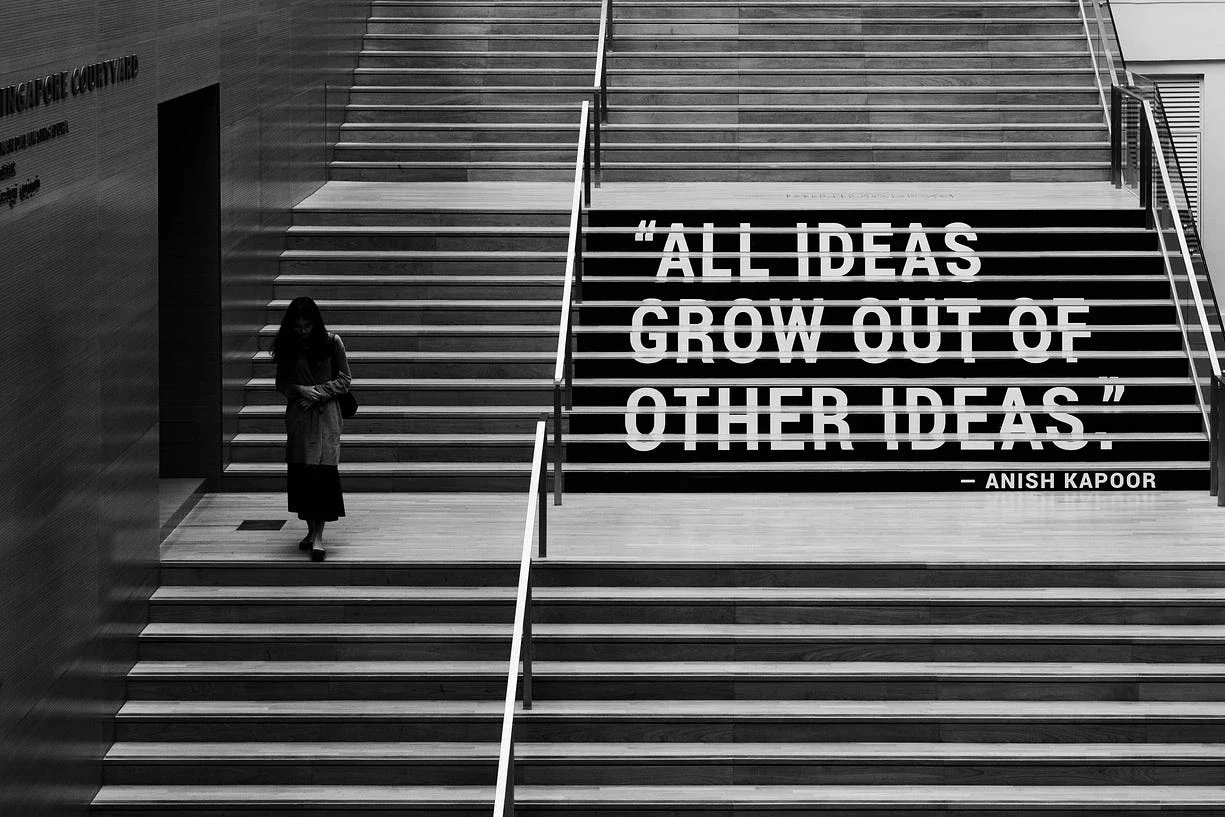
Repeating ideas again and again and getting to the flow of it makes sense to the growth and exploring impossible. Who would have thought in the 1970s that the Internet will become the dominant force of humans in 2019? The small ideas that bring us together to achieve great things. No matter how small the idea is, if it is nurtured with the right resources, it can change the course of our understanding altogether.
These ideas make our world a better place. Ideas are important to lead the curiosity of humankind.
The Quintessential Element: Adopt the habit of constructive change
Without the above 4 elements in life, this one is not possible. There is a say, “The only thing that is constant in this universe is — Change” It is static and yet constructive. We need to develop this character to change for good. When I followed those 4 elements in my life, it demanded a change from me. I never feared for a failure, always asked questions. Tried to change others who are arguably adamant for changing themselves for good. I failed to change them but still, I am successful in changing vital few from trivial many.
The biggest success I have have ever had till now is myself. I am now, accepting what it is there. My flow of ideas — I never sit back without executing it. It doesn’t matter whether I get more followers or visits. Failure has become my sole friend. I learn from it every time I fail. Try not to repeat mistakes. Changing yourself is the demand you make when you start adopting better things in life.
A small task that helped me to understand the world how it is — It suggested that when you see things that you are doing, it helps to achieve what you think of an idea more than closed eyes. Try it out for yourself in Try this section. (Point 5)
Highlights:
Here are the highlights that I have made from my reading.
- Brilliant students and brilliant innovators create their victories by practicing habits of thinking that inevitably carry them step-by-step to works of greatness.
- The most fundamental ideas in any subject can be understood with ever-increasing depth.
- By building on from foundations you will soon see your true abilities soar higher and faster.
- We associate understanding with the element Earth because when we attain a rich understanding, we are standing upon rock-solid, from the ground. Earth is that which is under where we stand.
- Mistakes are actions we definitely can take at any time. If you’re stuck, a mistake can be just the thing to unstick you.
- Failure is a critical element of effective learning, teaching, and creative problem-solving. Mistakes direct our attention in productive ways by forcing us to focus on the specific task of determining why the attempt at hand failed.
- Mistakes and failure are not signs of weakness; instead, they are opportunities for future success.
- The very act of creating questions, for yourself, is a profound step toward understanding — even if the questions are neither asked nor answered.
- “Even when you do know the answer, asking, “What if…?” is a great way to see more and delve deeper.”
- “What if…?” questions invite you to see the world differently because those questions force you to challenge the status quo and to explore the limits of your understanding.
- The right questions can be incredibly powerful tools for understanding and learning. Great questions can lead to insights that will make a difference.
- Questions give us a breath of inspiration and insight; thus, it is associated with the element Air.
- New ideas today are built on the ideas of yesterday and illuminate the way to the brilliant ideas of tomorrow.
- Solutions to little problems generate solutions to great problems.
- Successful and effective learners and innovators harness the power of the flow of ideas, which suggests the element Water.
- The ability to change is part of who you are, then you are liberated from worry about weaknesses or defects because you can adapt and improve whenever you like.
Tips:
The tips that can help understand the whole concept of the book:
- The building blocks of effective thinking,
- Understand deeply: Don’t face complex issues head-on; first understand simple ideas deeply.
- Make mistakes: Fail to succeed. Intentionally get it wrong to inevitably get it even more right.
- Raise questions: Constantly create questions to clarify and extend your understanding.
- Follow the flow of ideas: Look back to see where ideas came from and then look ahead to discover where those ideas may lead.
2. You only need to recall the classical elements that were once believed to be the essential parts of all nature and matter. Those elements, which predate Socrates and influenced Renaissance culture and thought, are Earth, Fire, Air, and Water. These elements are a reminder of the essential thinking that we need to learn. The 5 essential elements of effective thinking.
- Earth — Understand deeply
- Fire — Make mistakes
- Air — Raise questions
- Water — Follow the flow of ideas
- The Quintessential Element — Change
Try this:
- Consider a skill you want to improve or a subject area that you wish to understand better. Spend five minutes writing down specific components of the skill or subject area that are basic to that theme. Your list will be a free-flowing stream of consciousness. Now pick one of the items on your list, and spend thirty minutes actively improving your mastery of it. See how working deeply on the basics makes it possible for you to hone your skill or deepen your knowledge at the higher levels you are trying to attain. Apply this exercise to other things you think you know or would like to know.
- The next time you face a daunting challenge, think to yourself, “For me to resolve this issue, I will have to fail nine times, but on the tenth attempt, I will be successful.
- Consider an idea or topic you are trying to better understand, and create a list of fundamental questions that will guide you to a complete explanation, including motivation, examples, overview, and details of that subject.
- With those questions (and their corresponding answers) in hand, prepare a minilecture and consider delivering it to some audience — family, friends, or even a teacher. Ask them questions to measure how well you understood and articulated your message.
- Grab a piece of paper and a pencil. Close your eyes tightly and write the sentence “I am writing as neatly as I can and any mistake I make is unintentional.” Now open your eyes and look at what you’ve written…it’s not perfect. Now repeat the exercise but this time with your eyes open. Your result will (hopefully) be much better. Writing with your eyes open is a different (and easier) task than writing with your eyes closed.
Conclusion:
It does it all for ourselves. When I started to read this book, it took me 2 days to complete and hoped to change my habits. I kept discussing these concepts from the people I found and noted their ideas and questioned them. Along the way, I learned to control the flow of ideas and accept failures that I have faced in my life. Those series of failures helped me to raise questions about myself and my values. A person eliminates his/her values when they modulate their situations in life from survival to happiness. This doesn’t hold for all of them but most of us do the same.
Values are the ones that decide who we are and what we become. Acceptance is truely in the hands of us. When we follow these 5 remarkable habits in our life, we ought to see some major changes in life that can be adopted through minor decisions.